From Nginx Ingress to Kubernetes Gateway API: A Production Cutover Story
Production Deep Dive — Real problems, non-obvious solutions, working code.
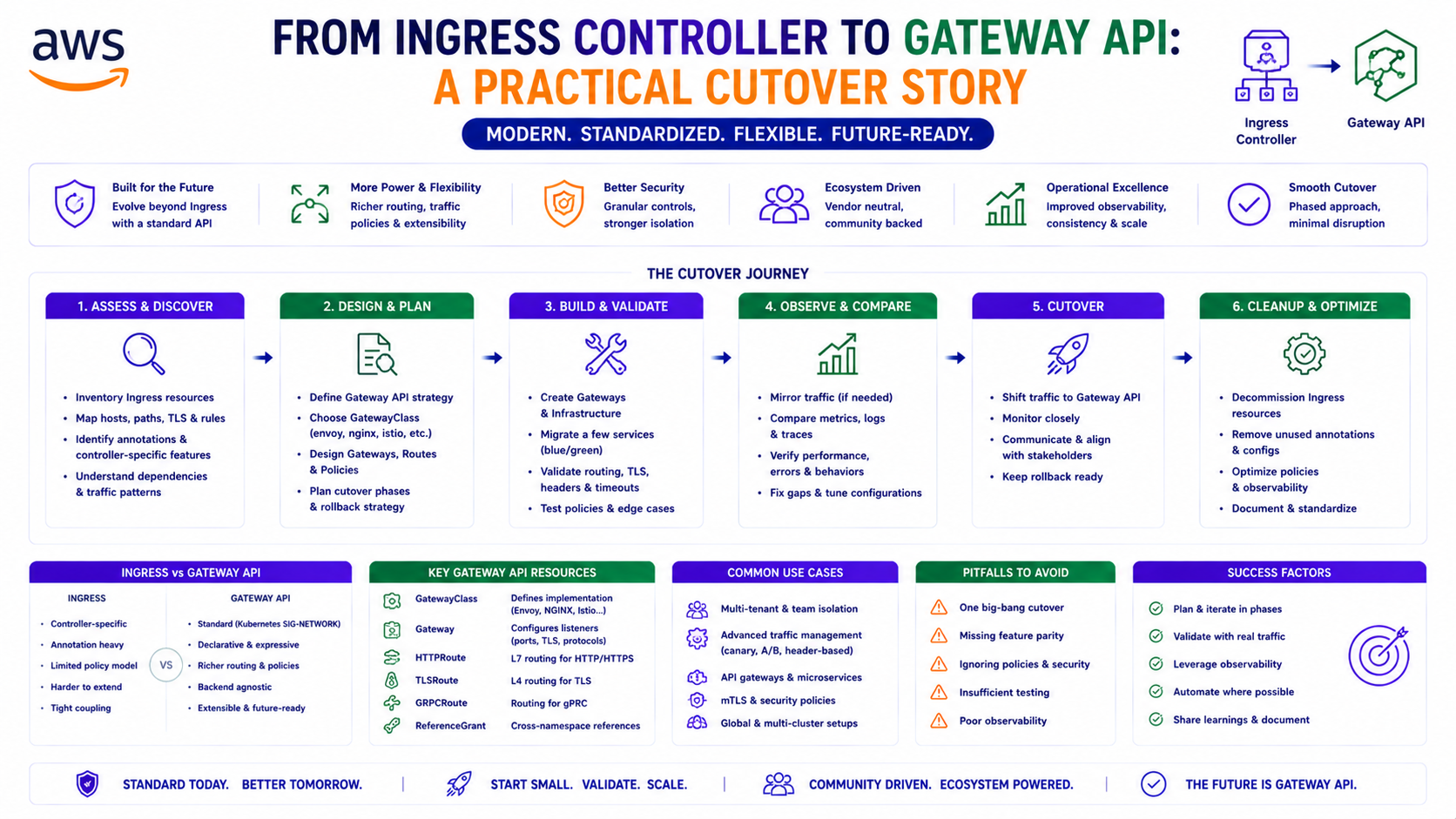
TL;DR
| Concern | Nginx Ingress (Before) | Gateway API (After) |
|---|---|---|
| Routing model | Controller-specific annotations | Portable, role-oriented resources |
| Load balancer | NLB (L4) fronting Nginx pods | ALB (L7) provisioned by the AWS Load Balancer Controller |
| Traffic path | DNS → NLB → Nginx pods → Service → Pod | DNS → ALB → Service → Pod (no in-cluster L7 hop) |
| Rewrites | Hidden in annotations and snippets | Explicit URLRewrite filters in HTTPRoute |
| Ownership | Mixed infra/app concerns in one Ingress | Platform owns Gateways, apps own HTTPRoutes |
| Route health | Controller-specific | Standard Accepted + ResolvedRefs conditions |
| DNS automation | Ingress-based | ExternalDNS reads HTTPRoute intent |
| External vs internal | Ingress class annotation | First-class external/internal Gateways |
The migration was done in test first — remove Nginx Ingress entirely, serve all traffic through Gateway API. The hard part wasn't the happy path. It was a healthy route quietly sending traffic to the wrong application.
Why Move Away From Nginx Ingress?
Nginx Ingress served the platform well — host-based routing, path-based routing, regex rewrites, TLS termination, internal and external ingress classes, and a handful of application-specific behaviours. It worked.
But as the platform matured, the Gateway API became the better target for specific reasons:
- Clearer ownership separation — infrastructure teams own load balancer policy, application teams own routing
- Native external/internal Gateway modelling — not an annotation, a first-class resource
- Better alignment with the AWS Load Balancer Controller — a direct path from the ALB to application targets, without an in-cluster L7 proxy (Nginx) as a required hop
- First-class route status —
AcceptedandResolvedRefsconditions tell you exactly what a route is doing - Cleaner DNS automation — ExternalDNS reads
HTTPRouteresources directly as a source
The deeper reason: Nginx makes routing behaviour implicit. Regex matching, rewrite targets, snippet-based rewrites, and ingress class behaviour quietly become part of the application contract — buried inside annotations that nobody reads until they break. The Gateway API forces those contracts into explicit, versioned route rules. The migration work is the price; visible, reviewable routing is the reward.
The Target Architecture
Two Gateways, by traffic exposure:
Public client
  → Public DNS
  → External Gateway (internet-facing ALB, via AWS LB Controller)
  → HTTPRoute host/path rule
  → Kubernetes Service
  → Application pod

Private client
  → Private DNS
  → Internal Gateway (internal ALB, via AWS LB Controller)
  → HTTPRoute host/path rule
  → Kubernetes Service
  → Application pod
Replacing the old model:
Client
  → DNS
  → Nginx ingress load balancer
  → Nginx ingress controller   ← the extra in-cluster hop being removed
  → Ingress host/path rule
  → Kubernetes Service
  → Application pod
Each Gateway is backed by an Application Load Balancer provisioned by the AWS Load Balancer
Controller, which now implements the Gateway API directly. Application Helm charts render
HTTPRoute resources and attach them to the correct Gateway via parentRefs. The
headline benefit is not removing Nginx — it is making route ownership explicit at the Gateway API layer.
The Load Balancer Change — NLB to ALB
This migration also changed the load balancer itself, not just the routing resources. The two models put the L7 routing in completely different places:
- Before: a Network Load Balancer (NLB) fronted the Nginx Ingress controller. The NLB is L4 — it does not understand HTTP. It simply forwarded traffic to the Nginx pods, and Nginx did all the host/path routing, rewrites, and TLS inside the cluster. The L7 brain lived in pods you had to run, patch, and scale.
- After: the AWS Load Balancer Controller provisions an Application Load Balancer
(ALB) per Gateway. The ALB is L7 — it does the host/path routing and rewrites itself, directly
from the
HTTPRouterules, and forwards straight to the Service targets. There is no Nginx pod in the path at all.
That is the in-cluster L7 hop the TL;DR refers to: moving from "NLB → Nginx pods (L7) → Service" to "ALB (L7) → Service" removes an entire tier of software you owned. The trade-off is that your routing now lives in ALB listener rules generated by the controller — which is exactly why inspecting those generated rules becomes a core debugging skill later in this post.
Why this matters in production: An NLB-plus-Nginx setup means you operate the L7 layer — Nginx upgrades, CVEs, pod scaling, and config reloads are all yours. Moving the L7 decisions onto an ALB driven by the AWS Load Balancer Controller hands that operational surface to a managed service. You trade a component you run for listener rules you read.
Step 1 — Inventory Every Ingress Path
The first rule of this migration: do not move only the obvious paths.
Ingress configurations contain far more than / routing. In this environment, application
behaviour depended on regex paths, prefix paths, rewrite targets, public and private hostnames, admin UI
paths, OAuth login and callback paths, identity provider endpoints, legacy path aliases, and static
configuration endpoints.
For each application, the inventory answered four questions:
- Which hostnames does this app own?
- Which paths does it expose publicly?
- Which paths does it expose privately?
- Which paths depend on Nginx-specific rewrite behaviour?
This mattered most for the admin application. The old Nginx setup had both an external API rewrite and a broad private root route — plus a separate static Ingress that rewrote short configuration paths into backend API paths. Those had to be preserved in Gateway API, not approximated.
Why this matters in production: The paths you forget are the paths that break login at 2am. An OAuth callback path or a legacy alias that lived quietly inside an Nginx annotation does not announce itself — it just stops working after cutover, and the failure looks like an application bug, not a routing gap. Inventory exhaustively before you write a single HTTPRoute.
Step 2 — Translate Nginx Rewrites to Gateway API Filters
Nginx expresses rewrites through annotations:
nginx.ingress.kubernetes.io/use-regex: "true"
nginx.ingress.kubernetes.io/rewrite-target: /api/$1
Gateway API has no annotations. It models rewrites as explicit filters on the route:
filters:
  - type: URLRewrite
    urlRewrite:
      path:
        type: ReplacePrefixMatch
        replacePrefixMatch: /api/
A legacy regex admin API route:
/admin/api/(.*) → /api/$1became an explicit Gateway prefix rewrite:
/admin/api/ → /api/Short configuration paths translated into explicit, readable route rules:
/w/configuration  →  /api/configuration-entries/platform/web
/i/configuration  →  /api/configuration-entries/platform/ios
/a/configuration  →  /api/configuration-entries/platform/android
This was one of the most useful moments in the migration. Nginx let these behaviours hide inside annotations and snippets. The Gateway API forced them into visible, versioned route rules that a reviewer can actually read in a pull request.
The Gateway API Building Blocks
The migration walkthrough above is the story. This section is the config — the actual
GitOps resources that stand up the ALB-backed Gateway API layer, with every environment-specific value
replaced by a <placeholder>. The whole thing is driven through ArgoCD with sync-waves, so
the ordering you see in the annotations is load-bearing: CRDs first, then load balancer config, then Gateways,
then HTTPRoutes.
Step 0 — Install the Gateway API CRDs (sync-wave -1)
The Gateway API is not built into Kubernetes — the CRDs have to be installed before anything else can
reference them. Two sets are needed: the upstream Gateway API standard CRDs, and the AWS Load Balancer
Controller's own Gateway CRDs (the LoadBalancerConfiguration kind that lets you configure the
ALB). A bootstrap Job handles both, ordered ahead of everything via sync-wave: "-1".
# gateway-api-crds — values.yaml
gatewayApiVersion: "v1.3.0"
installExperimental: true
# AWS LBC gateway CRDs source ref — must match your controller major version
awsLbcGatewayCrdsRef: "v3.0.0"   # v3.x LBC ships native Gateway API support
# install-crds-job.yaml — runs before the controller (sync-wave -1)
apiVersion: batch/v1
kind: Job
metadata:
name: install-gateway-api-crds
namespace: kube-system
annotations:
argocd.argoproj.io/sync-wave: "-1"
argocd.argoproj.io/sync-options: Replace=true
spec:
ttlSecondsAfterFinished: 600
template:
spec:
serviceAccountName: gateway-crd-installer
containers:
- name: install-crds
image: bitnami/kubectl:latest
command:
- /bin/sh
- -c
- |
set -e
# 1. Upstream Gateway API standard CRDs
kubectl apply -f https://github.com/kubernetes-sigs/gateway-api/releases/download/v1.3.0/standard-install.yaml
# 2. Experimental CRDs (optional — for features not yet in standard)
kubectl apply -f https://github.com/kubernetes-sigs/gateway-api/releases/download/v1.3.0/experimental-install.yaml
# 3. AWS LBC Gateway CRDs (LoadBalancerConfiguration kind)
kubectl apply -f https://raw.githubusercontent.com/kubernetes-sigs/aws-load-balancer-controller/v3.0.0/config/crd/gateway/gateway-crds.yaml
restartPolicy: OnFailure
backoffLimit: 3Why this matters in production: The AWS Load Balancer Controller's Gateway API
support arrived in the v3.x line. The version of the controller, the version of the Gateway API CRDs, and the
AWS LBC Gateway CRDs all have to agree — a mismatch shows up as a Gateway that never gets
Programmed=True and gives you very little to debug. Pin all three versions explicitly and install
the CRDs as an ordered bootstrap step, not by hand.
Step 1 — The Two GatewayClasses
A GatewayClass is the template that ties Gateways to a controller and a configuration. We run
two — one for the internet-facing ALB, one for the internal ALB — each pointing at its own
LoadBalancerConfiguration via parametersRef.
# External GatewayClass — internet-facing ALB
apiVersion: gateway.networking.k8s.io/v1
kind: GatewayClass
metadata:
  name: aws-alb-gateway-class
  annotations:
    argocd.argoproj.io/sync-wave: "1"
spec:
  controllerName: gateway.k8s.aws/alb
  parametersRef:
    group: gateway.k8s.aws
    kind: LoadBalancerConfiguration
    name: external-alb-config
    namespace: kube-system
---
# Internal GatewayClass — internal ALB
apiVersion: gateway.networking.k8s.io/v1
kind: GatewayClass
metadata:
  name: aws-alb-internal-gateway-class
  annotations:
    argocd.argoproj.io/sync-wave: "1"
spec:
  controllerName: gateway.k8s.aws/alb
  parametersRef:
    group: gateway.k8s.aws
    kind: LoadBalancerConfiguration
    name: internal-alb-config
    namespace: kube-system
Step 2 — The LoadBalancerConfiguration (where the ALB is actually configured)
This is the AWS-specific resource that the GatewayClass references. It is where scheme, subnets, security
groups, SSL policy, and WAF association live — everything that used to be Nginx annotations now lives here as
structured config (sync-wave 0, before the Gateways).
# External ALB configuration — internet-facing
apiVersion: gateway.k8s.aws/v1beta1
kind: LoadBalancerConfiguration
metadata:
  name: external-alb-config
  namespace: kube-system
  annotations:
    argocd.argoproj.io/sync-wave: "0"
spec:
  scheme: internet-facing
  loadBalancerSubnets:
    - identifier: <public-subnet-a>
    - identifier: <public-subnet-b>
  securityGroups:
    - <external-alb-security-group-id>
  loadBalancerAttributes:
    - key: idle_timeout.timeout_seconds
      value: "60"
    - key: routing.http2.enabled
      value: "true"
  listenerConfigurations:
    - protocolPort: HTTPS:443
      sslPolicy: ELBSecurityPolicy-TLS13-1-2-2021-06   # public AWS predefined SSL policy
  wafV2:
    webACL: <waf-web-acl-arn>          # WAF association — see Troubleshooting Lesson 4
---
# Internal ALB configuration — private
apiVersion: gateway.k8s.aws/v1beta1
kind: LoadBalancerConfiguration
metadata:
  name: internal-alb-config
  namespace: kube-system
  annotations:
    argocd.argoproj.io/sync-wave: "0"
spec:
  scheme: internal
  loadBalancerSubnets:
    - identifier: <private-subnet-a>
    - identifier: <private-subnet-b>
  securityGroups:
    - <internal-alb-security-group-id>
  loadBalancerAttributes:
    - key: idle_timeout.timeout_seconds
      value: "60"
    - key: routing.http2.enabled
      value: "true"
  listenerConfigurations:
    - protocolPort: HTTPS:443
      sslPolicy: ELBSecurityPolicy-TLS13-1-2-2021-06
  wafV2:
    webACL: <waf-web-acl-arn>
Why this matters in production: This is the single biggest readability win of the migration. Everything that used to be scattered across Nginx annotations — TLS policy, WAF, idle timeouts, HTTP/2, subnet placement — is now one structured, reviewable resource per load balancer. A reviewer can see the entire ALB posture in a pull request instead of reconstructing it from a dozen annotation strings.
Step 3 — The Gateways (sync-wave 2)
The Gateway defines the listeners — ports, protocols, hostnames, and TLS. Note the
wildcard listener pattern: a dedicated *.<test-domain> listener means new
applications can attach an HTTPRoute for their own subdomain without editing the Gateway itself.
# External Gateway — public listeners
apiVersion: gateway.networking.k8s.io/v1
kind: Gateway
metadata:
  name: external-gateway
  namespace: kube-system
  annotations:
    argocd.argoproj.io/sync-wave: "2"
spec:
  gatewayClassName: aws-alb-gateway-class
  listeners:
    - name: http
      port: 80
      protocol: HTTP
      allowedRoutes:
        namespaces:
          from: All
    - name: https
      port: 443
      protocol: HTTPS
      hostname: "api.<test-domain>"
      tls:
        mode: Terminate
        certificateRefs:
          - group: ""
            kind: Secret
            name: external-tls-dummy   # placeholder ref; real cert via ACM on the LB
      allowedRoutes:
        namespaces:
          from: All
    # Wildcard listener — new apps attach by subdomain, no Gateway edit needed
    - name: https-wildcard
      port: 443
      protocol: HTTPS
      hostname: "*.<test-domain>"
      tls:
        mode: Terminate
        certificateRefs:
          - group: ""
            kind: Secret
            name: external-tls-dummy
      allowedRoutes:
        namespaces:
          from: All
---
# Internal Gateway — private listeners (api, wildcard, and a dedicated auth host)
apiVersion: gateway.networking.k8s.io/v1
kind: Gateway
metadata:
  name: internal-gateway
  namespace: kube-system
  annotations:
    argocd.argoproj.io/sync-wave: "2"
spec:
  gatewayClassName: aws-alb-internal-gateway-class
  listeners:
    - name: http
      port: 80
      protocol: HTTP
      allowedRoutes:
        namespaces: { from: All }
    - name: https
      port: 443
      protocol: HTTPS
      hostname: "api.internal.<test-domain>"
      tls:
        mode: Terminate
        certificateRefs:
          - { group: "", kind: Secret, name: internal-tls-dummy }
      allowedRoutes:
        namespaces: { from: All }
    - name: https-wildcard
      port: 443
      protocol: HTTPS
      hostname: "*.internal.<test-domain>"
      tls:
        mode: Terminate
        certificateRefs:
          - { group: "", kind: Secret, name: internal-tls-dummy }
      allowedRoutes:
        namespaces: { from: All }
    # Dedicated identity-provider listener — see OIDC lessons below
    - name: https-auth
      port: 443
      protocol: HTTPS
      hostname: "auth.internal.<test-domain>"
      tls:
        mode: Terminate
        certificateRefs:
          - { group: "", kind: Secret, name: internal-tls-dummy }
      allowedRoutes:
        namespaces: { from: All }
Step 4 — An HTTPRoute Attached to a Gateway
Applications own their own HTTPRoutes and attach to a Gateway listener via parentRefs +
sectionName. This is the ArgoCD server's own route — attaching to the internal Gateway's
wildcard listener:
apiVersion: gateway.networking.k8s.io/v1
kind: HTTPRoute
metadata:
  name: argocd-httproute
  namespace: argocd
  annotations:
    argocd.argoproj.io/sync-wave: "3"
spec:
  parentRefs:
    - name: internal-gateway
      namespace: kube-system
      sectionName: https-wildcard     # which listener on the Gateway to attach to
  hostnames:
    - "argocd.internal.<test-domain>"
  rules:
    - matches:
        - path:
            type: PathPrefix
            value: "/"
      backendRefs:
        - name: argocd-server
          port: 80
For an application needing a rewrite (the admin API example from earlier), the rule carries a
URLRewrite filter:
rules:
  - matches:
      - path:
          type: PathPrefix
          value: "/admin/api/"
    filters:
      - type: URLRewrite
        urlRewrite:
          path:
            type: ReplacePrefixMatch
            replacePrefixMatch: "/api/"
    backendRefs:
      - name: admin-api-service
        port: 8080
Step 5 — ExternalDNS Reading HTTPRoutes
The final piece: ExternalDNS configured to treat HTTPRoutes as a DNS source
(--source=gateway-httproute). When an HTTPRoute is created with a hostname, ExternalDNS creates
the matching Route 53 record pointing at the right ALB — no manual DNS step. Two instances run: one for the
public zone, one for the private zone.
# external-dns (internal) — reads HTTPRoutes, manages the private zone
external-dns:
  provider:
    name: aws
  extraArgs:
    - --source=ingress
    - --source=gateway-httproute       # ← the key flag: HTTPRoute as a DNS source
    - --gateway-namespace=kube-system
    - --ingress-class=internal
    - --aws-zone-type=private
    # Keep TXT registry records off the CNAME names
    - --txt-prefix=extdns-%{record_type}-
  txtOwnerId: external-dns-internal
  policy: sync
  # ExternalDNS needs RBAC to read Gateway API resources
  rbac:
    additionalPermissions:
      - apiGroups: ["gateway.networking.k8s.io"]
        resources: ["gateways", "gatewayclasses", "httproutes"]
        verbs: ["get", "list", "watch"]
Why this matters in production: Wiring ExternalDNS to read HTTPRoutes is what makes
the whole layer self-service. A team ships an application with an HTTPRoute declaring its hostname, and DNS
appears automatically — pointed at the correct internal or external ALB. The RBAC block is the part people
miss: ExternalDNS cannot read Gateway API resources without being explicitly granted access to the
gateway.networking.k8s.io API group, and the symptom of forgetting it is silent — no records, no
obvious error.
How It All Fits — The Sync-Wave Order
sync-wave -1:  Gateway API CRDs + AWS LBC Gateway CRDs   (bootstrap)
sync-wave  0:  LoadBalancerConfiguration (external + internal)
sync-wave  1:  GatewayClasses (external + internal)
sync-wave  2:  Gateways (external + internal) → ALBs provisioned
sync-wave  3:  HTTPRoutes → routes attach, ExternalDNS creates records
That ordering is the difference between a clean argocd sync and a pile of resources that fail
because they reference CRDs or configs that do not exist yet. The dependency chain is real: a Gateway cannot
reference a GatewayClass that references a LoadBalancerConfiguration that has not been applied, and none of it
works before the CRDs are installed.
Step 3 — Split External and Internal Route Ownership
An early lesson: avoid unnecessary overlap between internal and external routes.
The first attempt attached one route to both Gateways with both public and private hostnames. That works in simple cases — and becomes very hard to reason about when a shared internal hostname accumulates many path rules from many applications.
The cleaner pattern separated them completely:
external route
  → external gateway only
  → public hostname only
  → public application paths

internal route
  → internal gateway only
  → private hostname only
  → private application paths
This made listener rules easier to inspect and made it obvious which application owned which internal path.
For the admin application, the internal route explicitly covered:
/admin-base-path
/login
/oauth2
/api
/
The broad / fallback preserved the old private Ingress behaviour, while the explicit
/login, /oauth2, and /api paths made login and application traffic
unambiguous in the shared internal load balancer rule table.
Why this matters in production: A single route spanning both Gateways feels efficient and becomes a debugging nightmare. When a shared internal hostname has fifty path rules contributed by a dozen applications, you want each application to own its slice explicitly. Clarity of ownership beats brevity of configuration every time.
Step 4 — Disable Ingress Before Removing Nginx
The cutover sequence was the safety mechanism.
We did not remove Nginx first. We proved Gateway API worked, then removed Nginx. The safe order:
1. Add GatewayClasses and Gateways
2. Add HTTPRoute resources for applications
3. Configure ExternalDNS to read Gateway API routes
4. Validate route acceptance and DNS
5. Disable application Ingress objects in test values
6. Remove stale static Ingress templates
7. Exclude Nginx ingress controller apps from the test ArgoCD ApplicationSet
8. Confirm no Ingress resources remain
9. Confirm no Nginx ingress pods, services, deployments, or Argo apps remain
Each step kept rollback options open until the Gateway path was proven. Nginx was decommissioned only after the Gateway layer was serving every path correctly.
Why this matters in production: Cutover order is risk management. Remove the old path first and a single missed route is an outage with no fallback. Build the new path alongside the old, prove it, then remove the old — and a mistake is a quick revert, not an incident. The boring sequence is the safe sequence.
Step 5 — Validate With Conditions, Not Hope
Gateway API exposes route health as standard conditions. We leaned on them heavily:
kubectl get httproute -A -o jsonpath='{range .items[*]}{.metadata.namespace}{"/"}{.metadata.name}{"\n"}{range .status.parents[*].conditions[*]}{" "}{.type}{"="}{.status}{" "}{.reason}{"\n"}{end}{end}'Every route had to show:
ResolvedRefs=True
Accepted=True
Plus the platform-level checks:
kubectl get ingress -A        # expect: none
kubectl get gateway -A        # expect: Programmed=True
kubectl get gatewayclass      # expect: Accepted=True
A clean cutover state:
Step 6 — Validate DNS From the Right Place
Private DNS was the easiest thing to misread.
Internal hostnames resolved correctly inside the VPC but not necessarily from a local machine — which is expected. Private hosted zones need the right resolver path, VPN, or bastion context. Validating private DNS from a laptop and panicking at the result is a classic false alarm.
Validation ran from an environment that could actually use the VPC resolver:
dig api.<test-domain>
dig api.internal.<test-domain>
dig auth.internal.<test-domain>
Expected:
- Public API hostname → public load balancer addresses
- Internal API hostname → private load balancer addresses
- Internal identity hostname → private load balancer addresses
Why this matters in production: Half of "DNS is broken" reports are really "I queried private DNS from a place that can't see private DNS." Validate from inside the network that actually uses the records. Otherwise you will chase a resolver problem that does not exist while the real cutover waits.
Troubleshooting Lesson 1 — A Healthy Route Can Still Send Traffic to the Wrong App
This was the most instructive issue of the entire migration. It was not a failed route. It was a wrong route.
The admin application login returned 504 Gateway Time-out. The admin internal
HTTPRoute looked perfectly healthy:
ResolvedRefs=True
Accepted=True
The target group was healthy too — the load balancer could clearly reach a backend. Everything the route status could tell us said the route was fine.
The breakthrough came from inspecting the generated load balancer listener rules. A different application still owned this path:
/admin-base-path/*That rule had a higher priority than the admin catch-all route and forwarded the admin login callback to the wrong service. The request never reached the admin pod — which is exactly why the admin application logs were empty. We were looking for the failure in the right app's logs, but the traffic was going to a different app entirely.
The fix: remove the misplaced route from the wrong application's chart and make the admin application explicitly own its login and callback paths.
Accepted=True means the route is valid. It does not prove that
another route isn't taking precedence for the same host and path. When debugging Gateway API on a cloud
load balancer, inspect the generated listener rules — route status describes one route in isolation, but
traffic is decided by all routes together, in priority order.
Troubleshooting Lesson 2 — Preserve Login and Callback Paths Explicitly
OAuth/OIDC flows are path-sensitive in ways that are easy to underestimate.
A single login can start at a friendly login page, redirect to the identity provider, return to a callback
path, request account metadata, and then load static frontend resources. If any one of those paths is
missing or routed to the wrong backend, the symptom is rarely a clean error — it surfaces as a login loop, a
blank page, a 401, a 404, a CSP warning, or a 504.
The important internal paths were made explicit rather than relying on a single / catch-all:
/login
/oauth2
/api
/admin-base-path
/
On a shared internal hostname with many applications and many generated load balancer rules, explicit beats implicit every time.
Troubleshooting Lesson 3 — App Context Path and Redirect URI Must Agree
Another failure came from a mismatch between where the application served and what the OAuth callback expected.
The live pod showed:
SERVER_SERVLET_CONTEXT_PATH=/So the correct callback was root-based:
https://api.internal.<test-domain>/login/oauth2/code/oidcnot the older base-path version:
https://api.internal.<test-domain>/admin-base-path/login/oauth2/code/oidcAfter correcting the environment configuration, the application still needed a restart to pick up the new OAuth client registration.
The lesson: during cutover, verify the live pod environment and rendered application configuration — not only the Git values. What's in Git is the intent; what's in the running pod is the reality, and during a migration those two drift more often than you'd expect.
Troubleshooting Lesson 4 — WAF Can Look Like an App Problem
The identity provider appeared to fail for some requests. WAF logs revealed the truth: managed bot rules were blocking HTTP-library-style requests while allowing normal browser traffic.
That distinction is sharp and important. A curl or Java-client request can be blocked while the
exact same flow succeeds in a browser. If you test with a script and it fails, you might "fix" an application
that was never broken.
For identity routes, the WAF allow rule needed to cover the internal identity host and the relevant OIDC paths — authorization, token, userinfo, discovery, and broker callback endpoints.
The lesson: when OIDC breaks behind a cloud WAF, check the WAF logs before changing application code. The request that never reaches your app cannot be fixed in your app.
Troubleshooting Lesson 5 — Restarts Still Matter
GitOps sync applied the desired manifests faithfully — but the running application kept using its previous behaviour until the deployment was restarted.
That is normal for many Spring-style applications: configuration, especially OAuth client registration and redirect URI settings, is read at startup. A GitOps sync changes the desired state; it does not always change the running state.
The final fix required a deployment rollout restart and a fresh browser session.
The lesson: after changing authentication configuration, include a rollout restart in the operational plan — unless the application is known to reload that configuration dynamically. "ArgoCD synced" is not the same as "the app picked up the change."
The Final Validation Checklist
# 1. No Ingress, all Gateway resources healthy
kubectl get ingress -A          # expect: none
kubectl get httproute -A        # expect: all Accepted=True, ResolvedRefs=True
kubectl get gateway -A          # expect: Programmed=True
kubectl get gatewayclass        # expect: Accepted=True

# 2. No Nginx remnants
kubectl get pods,svc,deploy -A | grep ingress-nginx     # expect: none
kubectl get applications -n argocd | grep ingress-nginx # expect: none

# 3. DNS resolves to the right load balancers
dig api.<test-domain>           # public host → external Gateway LB
dig api.internal.<test-domain>  # internal host → internal Gateway LB
dig auth.internal.<test-domain> # identity host → internal Gateway LB
Then the application smoke tests: public portal loads, internal portal loads, admin login succeeds, identity provider login succeeds, API endpoints respond, reporting/proxy/collector paths respond, and the ArgoCD UI remains reachable.
Recommendations for Teams Planning the Same Move
- Treat Nginx annotations as application behaviour, not implementation detail — they are part of your contract
- Build a path inventory before writing a single Gateway route
- Translate rewrites explicitly with Gateway API filters
- Split internal and external routes where it improves ownership clarity
- Watch for shared-host route priority conflicts — the silent killer
- Inspect generated load balancer listener rules when symptoms don't match route status
- Validate private DNS from inside the network that actually uses it
- Include WAF logs in the authentication troubleshooting workflow
- Restart applications after changing authentication configuration
- Keep Nginx decommissioning as the final step, never the first
Architecture Decision Matrix
| Concern | Nginx Ingress | Gateway API |
|---|---|---|
| L7 engine / load balancer | ❌ Nginx pods behind an NLB (you run the L7 tier) | ✅ ALB via AWS Load Balancer Controller (managed L7) |
| Maturity / familiarity | ✅ Battle-tested, widely known | ⚠️ Newer, smaller knowledge base |
| Routing expressiveness | ⚠️ Via controller annotations | ✅ Native, portable resources |
| Rewrite visibility | ❌ Hidden in annotations/snippets | ✅ Explicit filters |
| External/internal modelling | ⚠️ Ingress class | ✅ First-class Gateways |
| Ownership separation | ❌ Mixed in one resource | ✅ Gateway vs HTTPRoute split |
| Route health observability | ⚠️ Controller-specific | ✅ Standard conditions |
| DNS automation | ✅ ExternalDNS (Ingress) | ✅ ExternalDNS (HTTPRoute) |
| In-cluster L7 hop | ❌ Required (Nginx pods) | ✅ Removed (LB → Service) |
| Migration effort | — | ⚠️ Real — inventory + rewrites + testing |
The Golden Rule
"Migrating from Nginx Ingress to Gateway API is not a resource swap — it is making traffic ownership
visible. The happy path is straightforward: GatewayClasses, Gateways, HTTPRoutes, DNS. The migration's real
work is in the details Nginx let you ignore — a regex rewrite hiding in an annotation, an OAuth callback
path nobody inventoried, a stale route in the wrong chart silently outranking the right one.
Accepted=True tells you a route is valid, not that it wins. Build the new path beside the old,
validate with conditions and listener rules rather than hope, decommission Nginx last, and remember that a
GitOps sync changes desired state — not always the running process. Get the details right and the end state
is simpler than where you started: no controller, no Ingress, just explicit routes serving traffic."